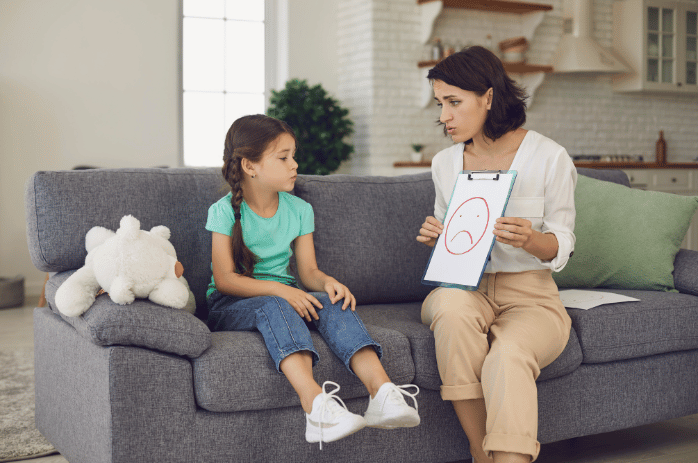
If you go to any kid-friendly space or attraction, including the London Children’s Museum, in London, Ontario, you will see a lot of kids experiencing a lot of big emotions and, subsequently, a lot of parents and caregivers trying their best to manage the situation and salvage the day. Parents and caregivers do not have to navigate their kids’ big feelings alone, in fact, child and/or family therapy are great resources to offer parents’ support in the areas of co-regulation and emotion coaching.
What Are “Big Feelings” and Why Do They Happen?
Big feelings can be categorized as intense reactions, such as anger, frustration, and excitement, that kids experience but have limited capability to regulate, in certain situations. These big feelings appear when kids do not have the vocabulary or the capacity to express their feelings in the moment. Kids do not have the same access to emotion vocabulary as adults, making it hard to express how they are feeling, leaving some kids feeling frustrated and dysregulated. Parents need to understand that acquiring emotional vocabulary is a learned skill that needs to be modelled by parents and other adults in their kids’ lives. Young children do not always have the ability to self-regulate, and therefore it is important for parents to meet the emotional needs of their children by co-regulating with them or offering them external support to help them regulate their big feelings and emotions. Emotion coaching can help parents and caregivers shift their focus from trying to manage their child’s big emotions to trying to understand their feelings.
The Science Behind “Big Feelings” and Co‑Regulation
When children are experiencing these big feelings and emotions, their prefrontal cortex, the logical part of their brain and the last part to develop, shuts down, and the amygdala, which is the emotional hub of the brain, takes over. The child is now not thinking logically and in turn is making choices based on heightened emotions.
Research has shown when parents co-regulate with their children during periods of big emotions and feelings, it offers both biological and behavioural benefits, which include hormonal attunement and regulation of the nervous system between parent and child, as well as fosters the socioemotional and cognitive development of the child. Co-regulation is also the predecessor to self-regulation, and a necessary healthy, developmental step for children.
Co‑Regulation in Real Life: How Child Therapy in London, Ontario Can Help Families
Child and family therapy can provide parents and caregivers with the tools and strategies to effectively implement emotion coaching, which helps their children navigate big emotions and feelings, while encouraging parents to start to understand the root cause of these feelings. The hope is to turn these moments of “big feelings” into opportunities to build sustainable skills toward better emotional regulation.
When a child is experiencing “big feelings”, experts recommend that parents first regulate themselves and their emotions. Parents or caregivers are then encouraged to get down, meeting their child at eye level and if able, offer them some physical contact or pressure in the form of a body squeeze or hug, while vocalizing or articulating their child’s feelings, such as “I see that you are really angry that someone was not listening to you”. Parents or caregivers should then try to encourage their child to slow down their breathing; engage in rhythmic breathing together. The child should then be directed to a quiet place to continue to decompress or offered a sensory tool to help with further regulation.
A child and family therapist, in London, Ontario, can offer parents and caregivers support to better navigate these big emotions and help their child on the path to self-regulation.


